From Kooser, Giebenhain

To my shame, I admit I am quite ignorant of most copyright laws. Does anyone (Renae?) know how to correctly share the following column? Thanks, Karma, for passing this on to me.

American Life in Poetry: Column 033
By Ted Kooser, U.S. Poet Laureate

Katy Giebenhain, an American living in Berlin, Germany, depicts a ritual that many diabetics undergo several times per day: testing one’s blood sugar. The poet shows us new ways of looking at what can be an uncomfortable chore by comparing it to other things: tapping trees for syrup, checking oil levels in a car, milking a cow.

Glucose Self-Monitoring

A stabbing in miniature, it is,
a tiny crime,
my own blood parceled
drop by drop and set
on the flickering tongue
of this machine.
It is the spout-punching of trees
for syrup new and smooth
and sweeter
than nature ever intended.
It is Sleeping Beauty’s curse
and fascination.
It is the dipstick measuring of oil
from the Buick’s throat,
the necessary maintenance.
It is every vampire movie ever made.
Hand, my martyr without lips,
my quiet cow.
I’ll milk your fingertips
for all they’re worth.
For what they’re worth.
Something like a harvest, it is,
a tiny crime.

Katy Giebenhain, Best of Prairie Schooner: Fiction and Poetry

“Becca!”

Yup, that’s what our favorite 20 month old wordsmith has been calling me the past two days.

Between referring to me by my first name and her crazy mood shifts, I think she’s hitting the teen years a little early.

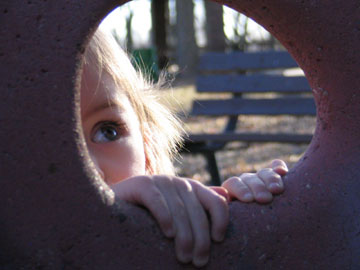
Playtime in the Park III

park_gleaminghair.jpg

Book Review – Hannah Coulter

Megan issued the invitation and I responded to it by checking out Hannah Coulter from a local library last week. The following is my review of the book.

In the beginning of the novel, when Hannah recalls that she knew little of husband Nathan as a boy—in the days before he crossed “the waters” for battle in Okinawa during World War II—I began to wonder what kind of story author Wendell Berry was going to tell. The reason for my confusion relates to the fact that Hannah was married, to someone other than Nathan Coulter, to a man who ended up dying in the war. At this very early point in the novel, I wasn’t sure where to place my interest: Was this a story of her second husband? Was it a tale of true love lost forever? Was Hannah Coulter now a bitter old woman? And for some odd reason, I never lost my tentative stance as a reader. Throughout the entire book I felt like I was trying to “figure out” the main point of the story. Now that I’ve read the entire thing, I surmise that there was no particular main point to grasp. The joy of Hannah Coulter is definitely in the telling, in the meandering paragraphs of her days on the farm, of the two loves of her life, and of relationships with friends and family.

Though the novel is endearing in many chapters, it isn’t the type of book I’d eagerly press into the hands of my friends. However, I found a few pieces of gold sprinkled throughout its pages and ended up scribbling quotes in my journal. On New Year’s Eve several friends and I toasted to “Hope without shame” in 2006. The following quote clarifies that sentiment:

Living without expectations is hard but, when you can do it, good. Living without hope is harder, and that is bad. You have got to have hope, and you musn’t shirk it. Love, after all, “hopeth all things.” But maybe you must learn, and it is hard learning, not to hope out loud, especially for other people. You must not let your hope turn into expectation. (p. 146)

Another section, this time related specifically to marriage, struck me as quite beautiful. I copied nearly an entire page because I like it so much:

It would be again like the coming of the rhymes in a song, a different song, this one, a long song, the rhymes sometimes wide apart, but the rhymes would come.

The rhymes came. But you may have a long journey to travel to meet somebody in the innermost inwardness and sweetness of that room. You can’t get here just by wanting to, or just because the night falls. The meeting is prepared in the long day, in the works of years, in the keeping of faith, in kindness.

The room of love is another world. You go there wearing no watch, watching no clock. It is the world without end, so small that two people can hold it in their arms, and yet it is bigger than worlds on worlds, for it contains the longing of all things to be together. You come together to the day’s end, weary and sore, troubled and afraid. You take it all into your arms, it goes away, and there you are where giving and taking are the same, and you live a little while entirely in a gift. The words have all been said, all permissions given, and you are free in the place that is two of you together. What could be more heavenly than to have desire and satisfaction in the same room? [emphasis mine]

If you want to now why ever in telling of trouble and sorrow I am giving thanks, this is why. (p. 110)

These quotes, for me, were the highlight of this book. Towards the end of the novel I began to lose interest in Hannah’s story. I found her thoughts on her children, who all moved away from home and completely lost interest in the family farm, tiresome and frustrating. It rang too closely to the “in my day things were so much better because…” complaint that frankly no one wants to hear. If Berry had perhaps been a little more concise in his storytelling, limiting the book to a central theme, it would’ve made for a simpler, more enjoyable read.
Playtime in the Park II

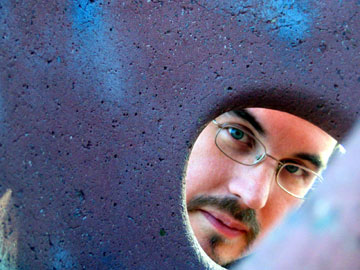
park_jeremy.jpg

In general, my husband doesn’t like to have his picture taken. I usually have to coerce him to let me point and click in his direction. So not only was I pleased to capture Livia through the cylinder holes, I was happy to snap my husband’s visage as well.

I love this guy. And I really like the past two photos I’ve posted. They seem to capture the essence of my sweet family.

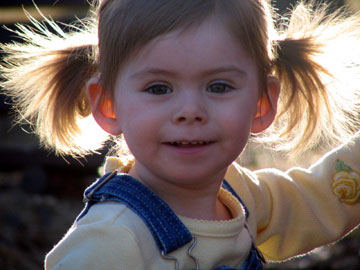
Playtime in the Park

park_livia.jpg

It’s 60 degrees. In mid January. In Nebraska.

spring.jpg

I am so looking forward to spring (my favorite season of all). Our current mild temps have me longing for days of warm breezes where I can sit on the front porch and soak up the sun all afternoon. Can’t wait to clear the dead brush from the gardens, spread a little mulch and make daily checks for green buds on the bushes. Crocuses will come up first, then daffodils and tulips. The neighborhood will be buzzing with children playing, college students and downtowners biking to their destinations and young men who play their car stereos too loud. We’ll invite the neighbors over for drinks on the porch and we’ll get to see other neighbors for the first time since winter.

Ahhhh…

Can’t wait for spring.

M-o-m

Dooce today cracked me up and reminded me of a recent exchange in my own house.

Jeremy: [while patting chest] Livia, who am I?

Livia: Da-dee.

Me: Who am I? [while thumping on my own chest]

Livia: Nana.

Me: [dejected but determined] No… Who am I? What’s my name?

Livia: Da-dee.

Me: [definitely dejected] No, no, no! I’m MAMA!! [thumping away furiously, thinking of all the diaper changes and bottle feedings completed with intense love and devotion]

The next morning…

Livia: [in crib, greeting me by patting her own chest] Mama. Mama. Mama.

Me: Close enough.

**Note: this child has been saying “Mama” for over a year now and definitely knows that I am her mother. Perhaps that’s why our little conversation drove me a little crazy.

20 Months and 1 Day

SHE WALKS!

Woohoo! Hallelujah, praise the Lord. My child WALKS! First three steps, from Grandma and Grandpa T’s hands to my arms. Jeremy walked into the living room just in time to see the big event. Then she took five steps, and later seven, with a pause in the middle and continued on without even falling down. Come to think of it, she didn’t hit the floor once. Our cautious kiddo isn’t really a faller. But now she’s a walker! Yay, Livia!!

Enjoying…

Elisabeth Elliot’s A Chance to Die
I started off not enjoying this book at all. Elliot’s verbose descriptions, perhaps encouraged after reading so many of Carmichael’s no-doubt wordy paragraphs, and the slow pace almost shut down my efforts. But I was very interested in the subject matter and eager to learn about the work of Amy Carmichael in India. I ended the biography impressed, and more than a little bit challenged, by the missionary’s all-consuming desire to serve the Lord.
Dancing with the Stars
I missed the summer installment of this show but, in a tired moment last night at 8pm, caught the new season premiere. Ballroom alone can’t hold my attention; pairing a “celebrity” novice with a professional however can. Livia even caught the excitement and swayed and clapped with vigor on my knees. Who knows? Maybe she’ll be a dancer someday. If she is, we’ll put Nana in charge costuming in order to maintain a proper level of conservative dress. (I discovered in a phone call that Mom didn’t so much like some of the skimpy outfits.)
Drunkard’s Prayer, Over the Rhine
This album is so so good, so so rich and full of beauty. Almost everything on my iPod is getting ignored for OTR these days.
Sleep
Thanks to Baby Tylenol Cough and Cold, Sesame Street (which got me about 15 desperately needed snooze minutes yesterday morning), my mom (who graciously provided about an hour of naptime yesterday afternoon), and God (who answered prayers in the affirmative last night). Yup, my poor babycakes has a yucko cold.
The Broker, John Grisham
Andrew left this one behind at my folks’ house, so I snagged it and read it voraciously in about three days. Intellectuals can poo-poo Grisham all they want—I love his stuff. For me it’s the novel equivalent of watching the DVD version of LOST. I get so far in mentally that I end up falling asleep at night rethinking that evening’s adventures. Good stuff.